Dragon Jamz HGB6 Open-String Scale Families
The following scale families form the foundation of the Dragon Jamz HGB6 Scale System. Each family contains the open-string notes of the HGB6 tuning (G – C – F – Bb) and can be viewed from either a major or relative minor perspective.
Eb Major / C Minor | Bb Major / G Minor | Ab Major / F Minor | F Major / D Minor
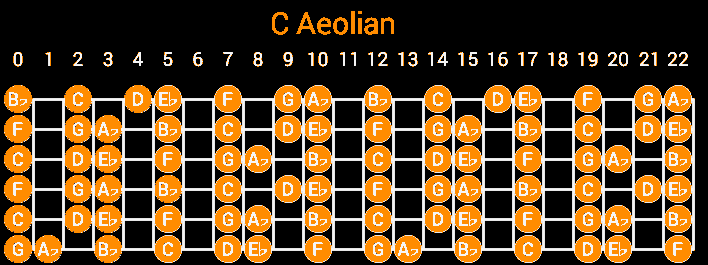
Eb Major / C Minor Family
Notes: Eb – F – G – Ab – Bb – C – D
Eb Major
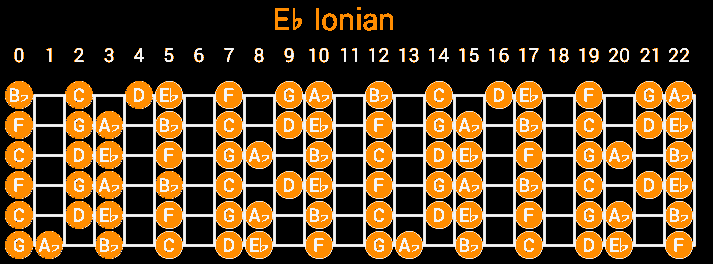
C Natural Minor
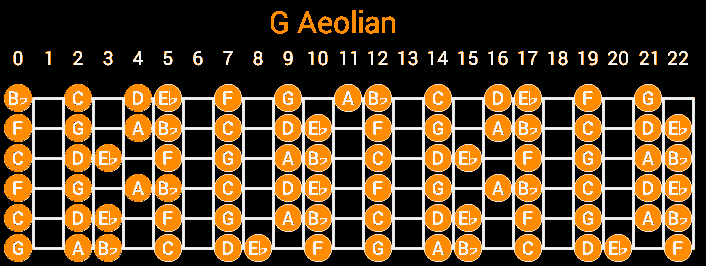
Bb Major / G Minor Family
Notes: Bb – C – D – Eb – F – G – A
Bb Major
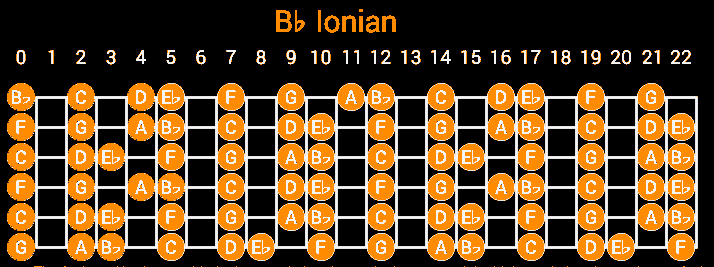
G Natural Minor
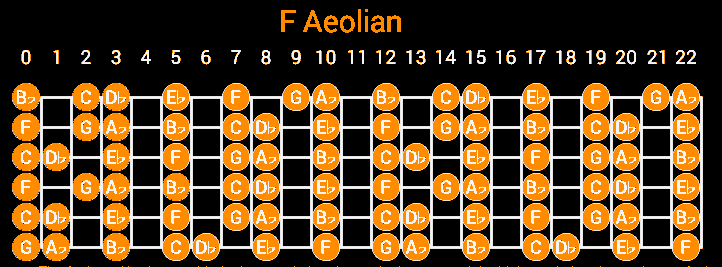
Ab Major / F Minor Family
Notes: Ab – Bb – C – Db – Eb – F – G
Ab Major
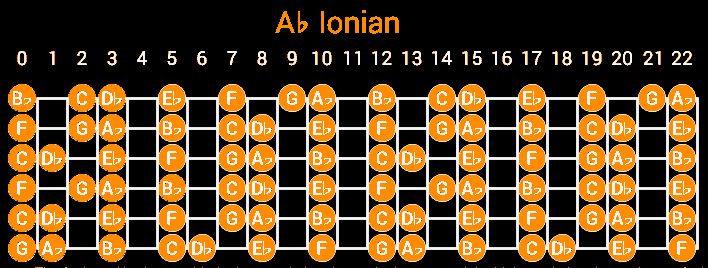
F Natural Minor
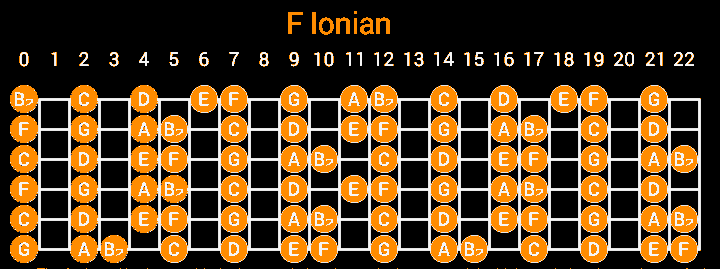
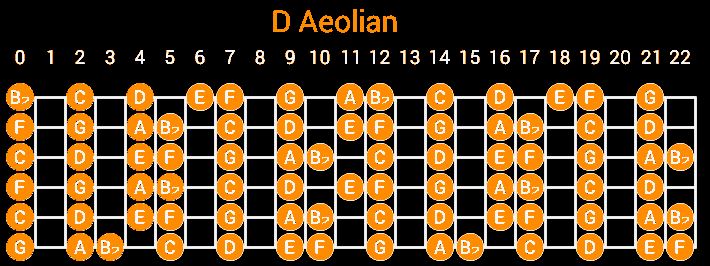
F Major / D Minor Family
Notes: F – G – A – Bb – C – D – E
F Major
D Natural Minor
Dragon Jamz HGB6 Jazz & Groove Vocabulary
These scales are commonly used for funk, blues, modal playing, jazz harmony, improvisation, and melodic development on the HGB6. While the Open-String Foundation Scale Families help establish fretboard familiarity, these scales introduce additional colors, tensions, and improvisational vocabulary.
G Vocabulary
Focus: Dominant sounds, blues vocabulary, funk grooves, modal jams, and altered harmony.
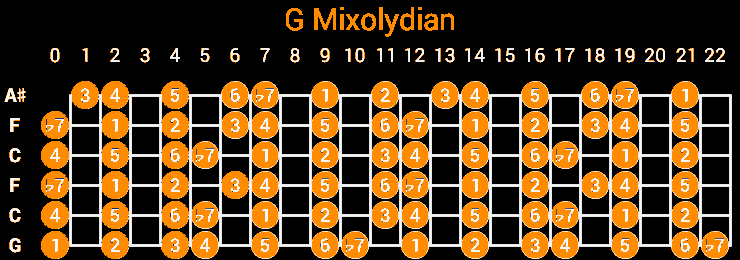
G Mixolydian
Notes: G – A – B – C – D – E – F
A foundational dominant scale used for G7, G9, G13, funk vamps, blues-based grooves, and dominant chord vocabulary.
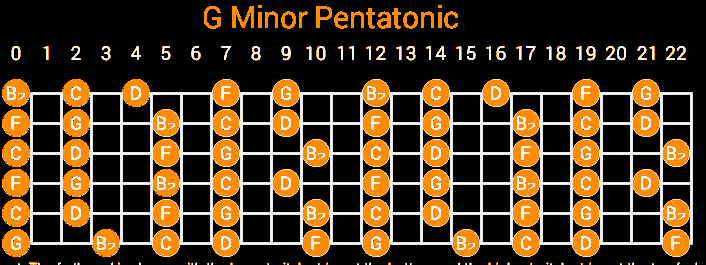
G Minor Pentatonic
Notes: G – Bb – C – D – F
A core groove, blues, funk, and improvisation scale. One of the most natural and useful scales on the HGB6.
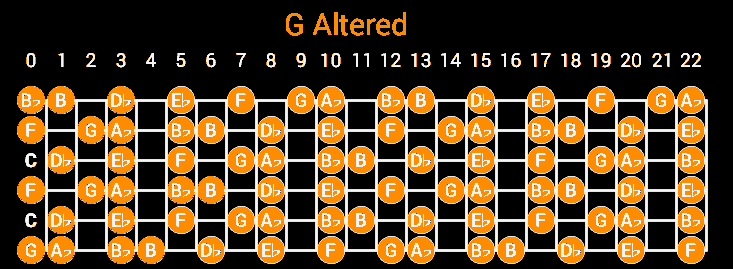
G Altered
Notes: G – Ab – Bb – B – Db – Eb – F
An advanced altered dominant sound used over G7alt, G7#9, G7b9, and other tension-rich dominant harmonies.
C Vocabulary
Focus: Minor harmony, jazz vocabulary, melodic development, and advanced harmonic color.
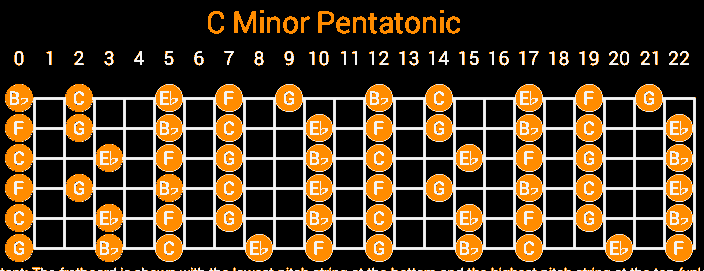
C Minor Pentatonic
Notes: C – Eb – F – G – Bb
A foundational minor pentatonic sound used for blues, funk, soul, melodic fills, and improvisation.
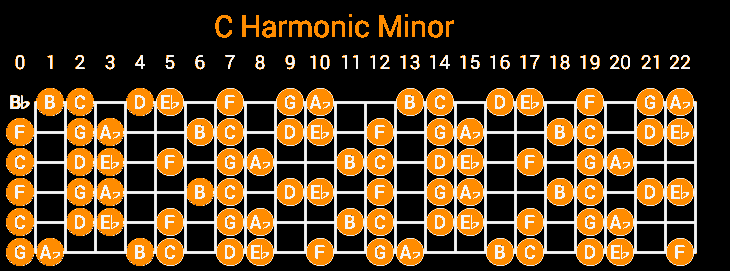
C Harmonic Minor
Notes: C – D – Eb – F – G – Ab – B
A natural minor scale with a raised 7th degree. Useful for minor-key harmony, stronger resolution, and traditional jazz minor sounds.
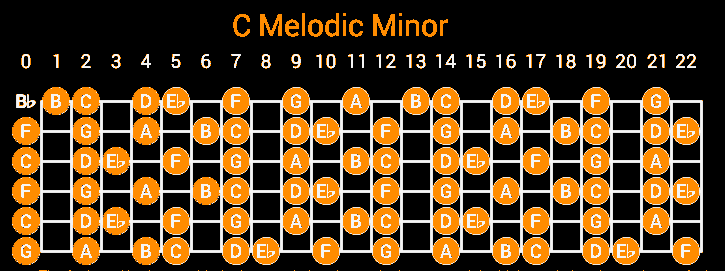
C Melodic Minor
Notes: C – D – Eb – F – G – A – B
A modern jazz minor sound featuring raised 6th and 7th degrees. Often used for CmMaj7 harmony and melodic minor vocabulary.
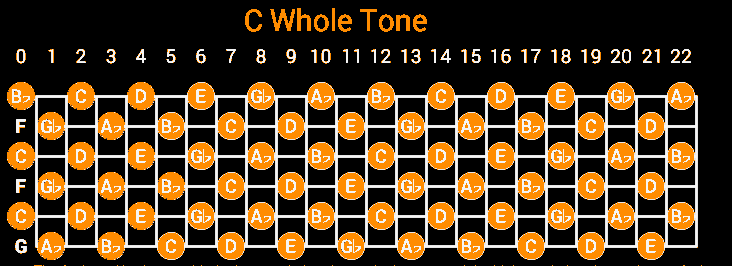
C Whole Tone
Notes: C – D – E – Gb – Ab – Bb
A symmetrical scale built entirely from whole steps. Useful for augmented sounds, dominant tension, and C7#5-style harmony.
Resources:
The HGB6 opens the door to unique scale patterns that take advantage of the instrument’s extended range and hybrid design. While many traditional guitar and bass concepts still apply, the Big 6 often reveals new pathways, fingerings, and musical possibilities that don’t exist on either instrument alone.
It’s also important to recognize that the HGB6 occupies a different space than a traditional guitar. Many players first approach the instrument expecting to play fast single-note lines and extended solos in the same way they might on a standard six-string. While that is certainly possible, the Hybrid Guitar often shines in a different role.
In many ways, the instrument feels closer to an organ than a guitar. Organ players can simultaneously perform chords, melodies, bass lines, and counterpoint using both hands and even their feet. The Hybrid Guitar pursues a similar musical goal, but with only two hands and six strings. As a result, every note represents a choice. Chords, bass movement, melody, harmony, and rhythm are constantly competing for space.
Because of this, scales on the HGB6 are often less about shredding and more about musical navigation. They can help connect chord voicings, add melodic movement between harmonic ideas, create simple counterlines, and introduce harmonizing notes that enrich a progression. Rather than existing solely as lead guitar tools, scales become part of a larger vocabulary that supports the instrument’s unique blend of bass, harmony, and melody.
This library is an ongoing collection of scale diagrams, patterns, and practical applications developed specifically for the HGB6 tuning:
G – C – F – c – f – a#
The goal is not simply to memorize shapes, but to understand how scales connect across the instrument and how they can be applied in real musical situations. Whether you’re exploring jazz standards, funk grooves, improvisation, chord melody, or original compositions, these patterns provide a foundation for navigating the HGB6 with confidence.
As the Dragon Jamz system continues to evolve, new scales, modes, and reference materials will be added. Like the instrument itself, this collection is a work in progress—documenting discoveries and helping build a shared knowledge base for the Hybrid Guitar community.
Explore the diagrams, experiment with the sounds, and make them your own.
 DRAGON JAMZ