Jazz Standards
Resources:
The HGB6 Charts Library is a growing collection of charts adapted specifically for the Dragon Jamz HGB6 System.
These charts are designed to help players apply HGB6 chord shapes, bass movement, groove concepts, and harmonic vocabulary in real musical situations. Rather than focusing on solo guitar arrangements, the material presented here is primarily built around a rhythm section approach to playing standards on the Hybrid Guitars Big 6.
The HGB6 is capable of performing bass lines, chords, and melodies simultaneously. However, the charts in this collection are generally intended for ensemble playing, where another musician is responsible for carrying the melody. The focus here is on supporting the music through comping, bass movement, harmonic accompaniment, and groove.
Dragon Jamz charts are designed to combine traditional jazz chart notation with practical HGB6 chord voicings.
Each measure displays the chord changes for the tune along with a recommended HGB6 chord shape directly beneath the chord symbol. This allows players to follow the form of the song while quickly locating playable voicings on the instrument without constantly referencing a separate chord dictionary.
When multiple voicings are available, the chart typically presents a primary shape chosen for playability, voice leading, and overall effectiveness within the arrangement. Additional voicings may be provided on a separate reference page for players who wish to explore alternative positions, registers, or tonal colors.
These charts are intended as practical performance tools rather than strict transcriptions. The goal is to provide a clear roadmap through the harmony while offering voicings that work naturally within the HGB6 system.
As the Dragon Jamz chart library grows, the formatting and voicing recommendations will continue to evolve alongside the instrument itself.
The voicings shown throughout the Standards Library use the Dragon Jamz HGB6 chord notation system.
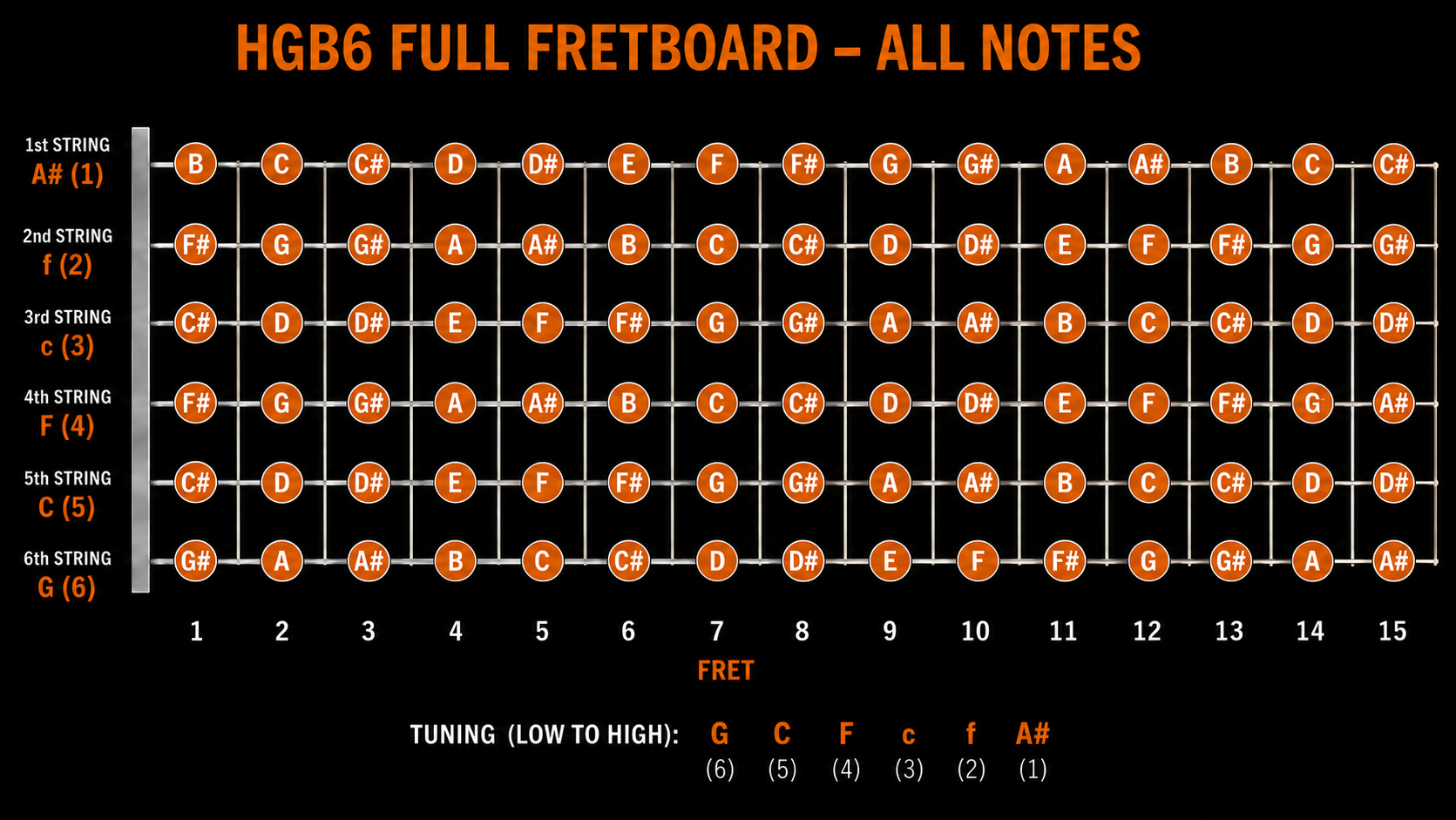
Chord shapes are written as six positions representing the six strings of the HGB6 from lowest to highest:
G – C – F – c – f – a#
Each number indicates the fret to be played on that string.
An X indicates that the string is not played.
For example:
X5XX44
means:
- G string = muted
- C string = 5th fret
- F string = muted
- c string = muted
- f string = 4th fret
- a# string = 4th fret
Likewise:
10XX9911
means:
- G string = 10th fret
- C string = muted
- F string = muted
- c string = 9th fret
- f string = 9th fret
- a# string = 11th fret
These formulas represent physical chord shapes rather than traditional chord diagrams. Because the shapes are written directly as fret positions, they can be read quickly while performing and allow players to visualize both the harmony and the location of the voicing on the neck.
Throughout the Standards Library, the primary and alternate voicings reference shapes found within the Dragon Jamz HGB6 Chord Database, creating a consistent system between the chord library and the chart collection.
These charts are not intended to be note-for-note transcriptions or complete chord-melody arrangements.
Instead, they present a practical framework for accompanying jazz standards on the HGB6. Many of the voicings draw inspiration from shell chords, jazz comping concepts, and practical rhythm guitar approaches adapted specifically for the Hybrid Guitar Big 6.
Players are encouraged to experiment with alternate voicings, rhythmic variations, bass movement, substitutions, and personal interpretation.
Each chart serves as a starting point for developing a deeper understanding of harmony, groove, and ensemble playing on the HGB6.
As the Dragon Jamz HGB6 System continues to grow, additional standards, arrangements, performance notes, and video demonstrations will be added over time.